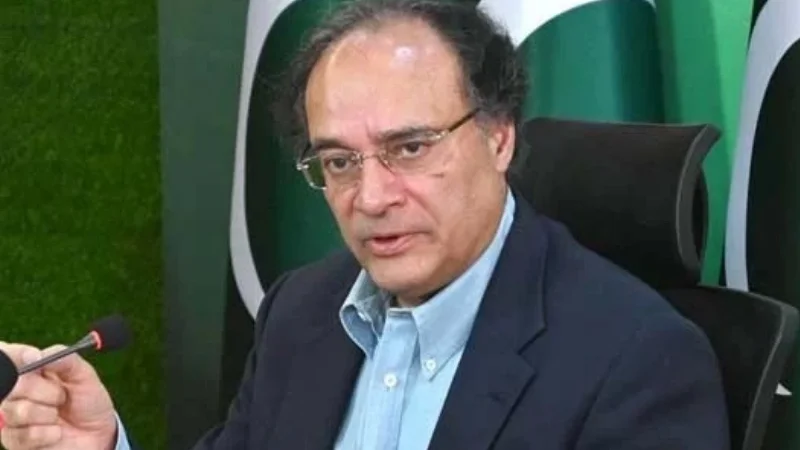
ISLAMABAD: Pakistan is pivoting its economic strategy from macroeconomic stabilization toward investment, trade and sustainable growth after making progress on key indicators, Finance Minister Muhammad Aurangzeb said Wednesday.
Speaking after a meeting with representatives of the Overseas Investors Chamber of Commerce and Industry, Aurangzeb said the government's priority is to consolidate stability while creating conditions for stronger, more sustainable economic growth.
"We have to take measures to carry forward macroeconomic stability," Aurangzeb said. "Our focus now, along with economic stability, is on sustainable economic growth."
He said improved economic indicators had benefited businesses and could help attract further investment, but cautioned that investment would not increase immediately simply because macroeconomic conditions had stabilized.
The government aims to raise investment to double-digit levels, he said, adding that restoring confidence among domestic investors was a necessary first step before attracting greater foreign investment.
Aurangzeb cited the participation of major domestic business groups in the privatization of Pakistan International Airlines as an example of increased local investor interest. The government is also pursuing the privatization of airports, insurance companies and other sectors, with interest from foreign investors including those from Saudi Arabia, he said.
He also pointed to Pakistan's issuance of a eurobond after a gap of about four and a half years as a sign of improved investor confidence, saying European and U.S. investors participated in the issuance.
Trade and Investment
Aurangzeb said Pakistan needed to move its engagement with bilateral partners beyond traditional relations and place greater emphasis on trade and investment.
Overseas chambers could help attract investment by engaging their international partners, while foreign companies already operating successfully in Pakistan should be encouraged to expand, he said.
Technology was another area with significant investment potential, particularly artificial intelligence, Web3 and blockchain, Aurangzeb said. He said AI could improve productivity across sectors such as agriculture, while Pakistan's freelancers and young workforce were already contributing to the information technology sector.
Pakistan earned about $1.6 billion from IT export services last year, he said, adding that the sector and freelancing industry needed to be scaled up further to create jobs, raise incomes and generate additional government revenue.
Investor Engagement and Tax Reform
Aurangzeb said continued engagement with investors was needed to identify areas where government policies were working and where further reforms were required.
OICCI President Omar Ahsan Khan said continuity in government policies was important for strengthening investor confidence, while former president Yusuf Hussain stressed the need to restore confidence among both domestic and foreign investors.
On taxation, Aurangzeb said the government had held several months of consultations with traders and other stakeholders on reforms. He said the government initially focused on consultation, negotiation and consensus while seeking to incorporate traders' proposals into the tax system. However, if efforts to broaden the tax base did not produce the desired results, enforcement would follow in accordance with the law.
The prime minister had also directed that the tax system should not contain barriers that discourage people from entering the formal tax net, Aurangzeb said.
Supply Chains and Subsidies
The minister said uninterrupted supply chains were critical for exports and economic activity, citing previous strikes that had disrupted shipments and taken weeks to resolve.
"Any disruption in the supply chain has a direct impact on exports," he said.
Aurangzeb also stressed the need to reduce government expenditure, saying Pakistan could not address its economic challenges through subsidies alone. Subsidies should be targeted at sectors and groups that genuinely need support, while public resources should be used efficiently to provide relief to citizens, he said.
On petroleum prices and levies, Aurangzeb said the government would assess developments in other countries and global markets before making decisions.
Exports and Localization
Pakistan needs to encourage new industries to focus on exports while promoting localization to reduce dependence on imports, Aurangzeb said. Industries must improve product quality and competitiveness and adapt their business and revenue models to changes in the global economy, he said.
"Exports are fundamentally important for sustainable economic growth," Aurangzeb said, adding that achieving growth rates of 6%, 7% or 8% would require managing the balance between imports and exports because faster economic activity also increases demand for imports.
He also called for reforms to become institutional rather than dependent on individuals.
"Individuals come and go, but institutions and systems continue," he said, warning that poorly designed economic decisions could slow growth.
Aurangzeb said inflation, which had previously been in double digits, had fallen into single digits, describing the improvement as an important part of the stabilization process. He said the government had spent about three years working toward economic stabilization and that its next priority was to strengthen the foundations for higher and sustainable growth.