Audi’s latest SUV brings curved OLED taillights, hundreds of customizable light segments and warning signals designed to alert drivers to potential hazards.
Audi is taking automotive lighting to a new level with the Q9, using OLED panels just 0.1 millimeters thick, roughly the width of a human hair to create curved taillights that wrap around the SUV’s rear.
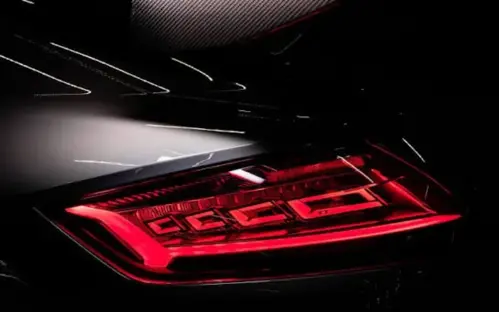
The technology combines eye-catching design with new safety features, including warning patterns that can alert other drivers to potential dangers. Audi calls the system its third-generation digital OLED rear lighting technology and says the Q9 is the world’s first production car to feature curved digital OLED panels.
The panels bend in three dimensions, helping make the lights visible from a wider range of angles, including from behind and along the sides of the vehicle. The technology builds on nearly a decade of Audi’s work with OLED lighting, which first appeared in the automaker’s TT RS.
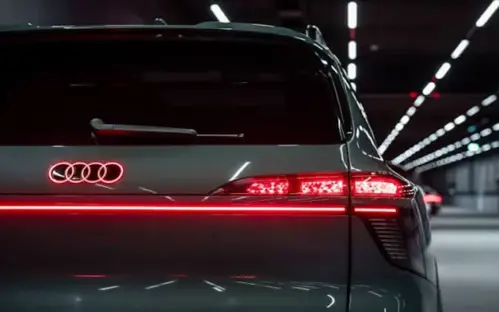
The Q9’s rear lighting system features six panels, each containing 512 individual segments, according to Audi. The outer curved panel has 99 segments, the largest number Audi has installed in a single panel.
The middle and inner panels contain 84 and 73 segments, respectively. Drivers can choose from eight lighting signatures through the vehicle’s multimedia interface, known as MMI.
For the first time, Audi says, some signatures can activate only part of the lighting pattern, creating distinctive visual effects at night. Beyond appearance, the system also serves a safety purpose.
When the Q9 detects a hazard or the driver activates the hazard lights, segments in the rear lighting system form a warning triangle to alert nearby motorists.
The feature adds another layer of communication between the vehicle and other road users, using the taillights to deliver a visual warning rather than simply illuminating the road behind the SUV. By combining digital OLED rear lights with digital Matrix LED headlights.
The Audi Q9 features an intelligent lighting system that actively contributes to safety and enables more effective communication between the vehicle and its surroundings. The advanced turn signal, first introduced in the Audi Q7, makes the Audi Q9 an active participant in traffic.
Audi first announced the Q9 in July, meaning the lighting technology is part of the vehicle’s previously introduced features rather than a new announcement this week. In the United States, the Q9 starts at $87,700. Audi says the curved OLED taillights come standard on Prestige trim models.