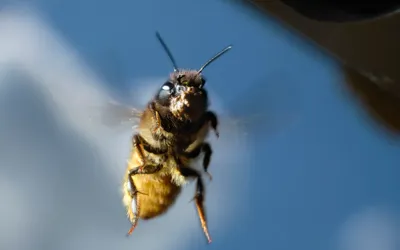
Scientists in China's Hunan province have unveiled a miniature drone resembling a mosquito, measuring barely the size of a human fingernail 0.6 cm.
Despite its toy-like appearance, this tiny robotic insect is designed for advanced reconnaissance and surveillance operations.
The drone features two yellow, leaf-shaped wings, a sleek black body, and three hair-thin legs, mimicking the appearance and movement of a real mosquito. Developed by researchers at a Chinese university, the device is intended for a variety of strategic uses, both military and civilian.
The device is designed for stealth. It is small enough to blend into natural environments and hard to detect by traditional security systems. Chinese scientists have packed communication gear, sensors, power units, and control electronics into its insect-sized body.
The drone’s four-winged version can be controlled by a smartphone and is part of NUDT’s wider work in bio-inspired robotics, including human-like machines and insect-scale flyers.
Chinese scientists have highlighted the drone's potential for "information reconnaissance and special missions on the battlefield," emphasizing its capability to access hard-to-reach areas. Experts suggest that the small size and quiet operation of these drones could enable them to infiltrate indoor spaces and secure facilities undetected.
Some of the security researchers have raised red flags. Timothy Heath, a defence expert, said such drones could be used by criminals to steal passwords or sensitive data. Tracey Follows, a futurist who previously worked with Google, warned that future versions could “carry deadly viruses or other harmful materials,” and might operate autonomously — without human control — making them even harder to regulate.
Security analysts, including Sam Bresnick of Georgetown University’s Centre for Security and Emerging Technology, note that such miniature drones could be employed for intelligence gathering, tracking individuals, or eavesdropping on conversations.
Similarly, Timothy Heath of the Rand Corporation pointed out that their low visibility makes them ideal for entering sensitive locations, including government facilities.
While the deployment of such tiny drones raises privacy and security concerns, their development signals a significant step forward in drone technology, opening new frontiers in surveillance capabilities.
As China progresses in this field, the global community watches closely to understand the broader implications of these miniature espionage tools.