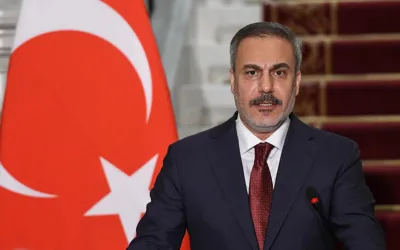
NEW YORK: Turkish Foreign Minister Hakan Fidan has defended the newly signed Makkah Joint Defence Agreement against criticism, saying it is too early to judge the alliance based on the long-running conflict in Yemen.
Speaking at a panel in New York on Turkey-US relations, Fidan was asked whether Houthi attacks from Yemen against Saudi Arabia represented the pact’s first test and how the alliance had performed.
Fidan pointed to former U.S. ambassador to Turkey James Jeffrey, who said he had been in the military for about 50 years, and asked how many times NATO’s Article 5 had been formally invoked during that period.
After the audience responded “once,” Fidan said it was unfair to describe the new alliance as ineffective while not applying the same standard to NATO.
“This is not fair,” Fidan said, according to the account of his remarks. “Nobody criticizes NATO by calling it a ‘paper tiger.’ But when it is a newly established defence alliance, they use a 10-year crisis as an example and say, ‘Look, this is not working.’ We have just started.”
His response drew applause from the audience.
The Makkah Joint Defense Agreement was signed by Türkiye, Saudi Arabia and Pakistan in August and includes a collective-defense commitment under which an armed attack against one signatory is regarded as an attack against all three. Fidan has previously described the agreement as technically similar to NATO’s Article 5.
Fidan said the agreement is intended to strengthen cooperation among regional countries while respecting their security, sovereignty and territorial integrity.
He said Türkiye, Saudi Arabia and Pakistan have a roadmap for implementing the pact and that its institutional structure could eventually allow other countries to join.
He said discussions over the agreement had continued for several years before the three countries finalized the pact.
Fidan has previously said the agreement does not identify Iran or any other country as a common threat. He has also described it as defensive in nature and said its practical implementation would depend on the circumstances of any future attack and the assistance requested by the affected member.
The comments came amid renewed scrutiny of the agreement following Houthi attacks on Saudi Arabia. On Sept. 19, Fidan said Türkiye was prepared to help meet potential Saudi military needs under the pact, particularly in technical areas.
Fidan said the alliance still has substantial institutional work ahead, including establishing mechanisms for defense cooperation, coordination and implementation.