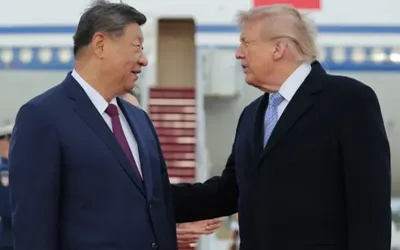
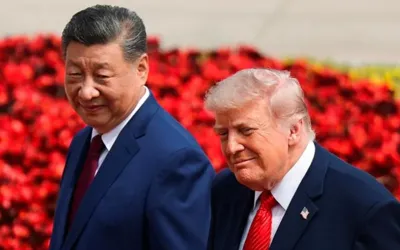
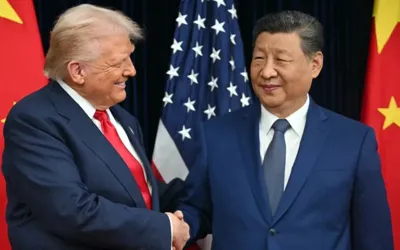
WASHINGTON: The United States remains heavily dependent on China for critical minerals despite President Donald Trump's efforts to strengthen domestic production, leaving Washington vulnerable ahead of his upcoming meeting with Chinese President Xi Jinping.
The Trump administration has launched several initiatives to reduce reliance on Beijing, including billions of dollars in public-private investments, financial support for mining companies such as Trilogy Metals and Lithium Americas, and Pentagon-backed processing partnerships with companies like MP Materials.
However, many American mining projects are still years away from reaching full production. As a result, US manufacturers continue to depend on Chinese supplies of essential minerals used in semiconductors, robotics, military equipment and artificial intelligence.
China maintains a significant advantage in rare earth production, particularly in manufacturing neodymium-iron-boron magnets.
The country has an annual production capacity of approximately 210,000 metric tons, compared with just 4,500 metric tons in the United States.
Experts say developing a complete domestic supply chain could take several years or even decades.
Major mining projects, including Thacker Pass and Perpetua Resources, are expected to begin production around 2028 and 2029, respectively.
Meanwhile, several major copper projects are not expected to expand significantly until 2031.
Even existing American production facilities face difficulties becoming fully integrated into complex industrial supply chains.
China's dominance in the critical minerals market gives Beijing considerable negotiating power, as America's defense, automotive and technology industries remain dependent on Chinese materials.
Previous restrictions imposed by Beijing on rare earth exports and magnets have already disrupted manufacturing operations at companies such as Ford, exposing weaknesses in American supply chains.
Ahead of the expected Trump-Xi summit, both leaders could seek to extend their fragile trade truce, which is scheduled to expire in January. The agreement includes temporary exemptions from export controls on certain critical minerals.
"The Chinese have been using the critical minerals choke collar on the US when they feel like it," said Rich Nolan, head of the National Mining Association.
Samir Kapadia, head of trade at the Vogel Group, said the gap between Trump's ambitions and the slow implementation of domestic mining projects highlights the difficulties of rebuilding.
China, meanwhile, maintains that its export restrictions are intended to prevent critical minerals from being used for military purposes. Beijing has also accused Washington of misusing export controls to limit semiconductor shipments to China.
Beyond mining, China has spent decades developing advanced processing facilities, technical expertise and manufacturing infrastructure to transform raw materials into industrial components.
These investments have further strengthened Beijing's position in global supply chains, making it difficult for the United States to quickly reduce its dependence on Chinese critical minerals.