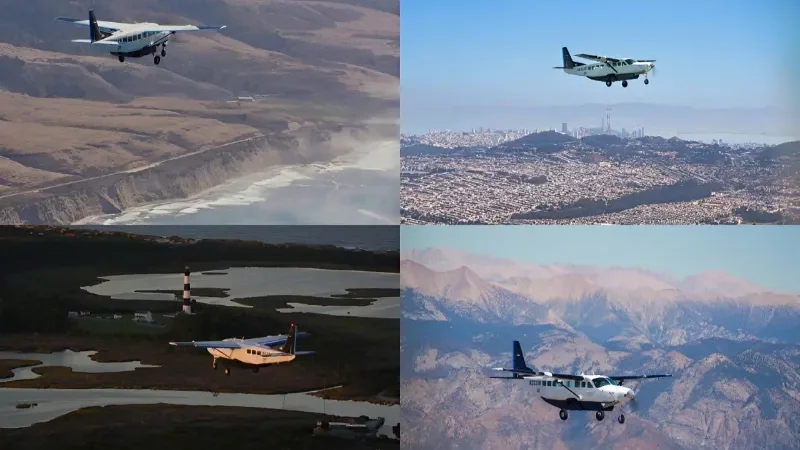
CONCORD: A flight with no pilot and a milestone that could reshape aviation. Joby Aviation’s autonomous J208 aircraft takes on a historic 3,199-mile journey across America, soaring from California’s Pacific coast over the mountains of the American West before reaching North Carolina’s Outer Banks near Kitty Hawk.
The flight was carried out without control inputs from the safety pilot aboard the aircraft. Joby Aviation, the company behind the technology, said the aircraft was operated autonomously under remote supervision from its Autonomy Headquarters in California and Shaw Air Force Base in South Carolina. The remote teams were able to supervise the aircraft from as far as 2,323 miles away.
The converted Cessna Caravan handled several major parts of the journey on its own, including taxiing, takeoffs, navigation and landings. The flight was designed to test the technology in different environments and situations.
During the trip, the aircraft operated in busy airspace, including Phoenix Deer Valley Airport, and adjusted its route around severe weather and thunderstorms in real time.
“This journey across America offers a glimpse into a new era of aviation,” JoeBen Bevirt, founder and CEO of Joby Aviation, said in a statement.
Bevirt said autonomous aircraft could eventually help deliver supplies to remote communities, support disaster response, transport medical equipment and assist military operations while reducing the need to place pilots in dangerous situations.
The flight was part of Joby's 2026 Electric Skies tour, which included demonstrations and logistics tests at several locations across the country. The aircraft stopped in Phoenix, Arizona, where Joby demonstrated potential uses for defense, emergency response and cargo operations.
It later traveled to Fort Worth, Texas, where the company highlighted the possible use of autonomous aircraft for freight and logistics. After crossing the country, the aircraft flew near the First Flight Monument in Kitty Hawk, North Carolina. The location is significant in aviation history because it is where brothers Orville and Wilbur Wright made their first powered flight in 1903.
The aircraft then landed at Dare County Regional Airport. Joby said the demonstration also showed how autonomous aircraft could support medical deliveries and emergency freight in areas that are difficult to reach by traditional transportation.
In North Carolina, the flights supported the state's eLIFT-NC program, which is examining the use of aircraft for health care logistics. Earlier flights in the western United States supported the uFLY coalition's work on integrating autonomous aircraft into complex airspace.
Joby said its autonomous flight system has completed more than 400 flights and 800 hours of automated flight operations in both controlled and uncontrolled airspace. The technology is based on an autonomy system developed by Xwing, whose autonomy division Joby acquired in 2024.
Joby also said its autonomous aircraft technology has been tested during three major U.S. military exercises. During one exercise, the company said an autonomous aircraft delivered replacement parts 24 hours faster than conventional logistics methods.
In another exercise in Hawaii, aircraft were remotely operated from Guam, nearly 4,000 miles away. The successful cross-country flight gives Joby another test of its autonomous aviation system as the company explores possible uses in cargo transportation, emergency response, medical logistics and defense operations.